So, I have finally figured out a way to keep up with this blog - make it a school project! It's genius.
In the fall, I intend to do my AHS (Arts and Humanities) Capstone on "feminist engineering". What is that, you ask? Haha! That is what my project will be about. I've taken a couple philosophy classes (spanning Western and Eastern disciplines) so I'm going to be building on that background with a women's studies angle.
My provisional thesis is:
Feminists are often concerned with women’s experiences and the effect of society in constraining and shaping those experiences. Therefore, with so much discussion surrounding the representation of women in engineering, it seems appropriate to bring a feminist lens to this arena.
Personal identity plays a huge role in how individuals interact with society and communities. In this context, what does it mean to balance identities as a feminist and as an engineer? How is that manifested in everyday life? If we approach this from a philosophical point of view, is it possible to do feminist engineering? What is it? Where might it come from?
By overlaying these seemingly disparate identities, we can begin to approach the issue of what it means to belong in engineering and how engineering might change as more and more women enter the field.
In any case, starting in the fall, I will be requiring myself to write one entry per week. Until then, my posts will probably be a little bit less focused and span book reviews to current events to stuff in my twitter feed to the power industry to boats to random things that occur to me.
Anyway, first dilemma: should my blog be anonymous? I can't decide. If I do go anonymous, I'll start a new one - otherwise, I'll keep using this one. I can imagine myself posting things and people getting mad at me for associating Olin with my rants. On the other hand, I hate secrets.
Showing posts with label philosophy. Show all posts
Showing posts with label philosophy. Show all posts
Saturday, June 27, 2009

Sunday, June 24, 2007
A Feminist Defense of Pornography
This summary is not available. Please
click here to view the post.
Thursday, June 14, 2007
Contraria sunt complementa
I really like Asian philosophy - the mysticism, the underlying unity of the universe, the henotheism (of Hinduism at least), the spiritual path, the pursuit of harmony. It all just sits well with me. In fact, I know I'm not the only one who feels that way - so I decided to read The Tao of Physics: An Exploration of the Parallels between Modern Physics and Eastern Mysticism by Fritjof Capra. Since I'm currently taking an Asian Philosophy course at UMBC, I felt that it would be a nice complement (and since I'm not reading the textbook, I might as well read something).
The first thing I noticed was that the book was categorized in the Physics section as opposed to the Philosophy section as I had expected. After a rough overview of quantum theory, relativity theory, and the major eastern philosophical traditions (Hinduism, Buddhism, Chinese Thought, Taoism, Zen), each chapter breaks down a different concept: the unity of all things, opposites as complements, space/time, emptiness, cosmic dance etc. (I skimmed the last couple chapters, I was starting to get overloaded). Much of the book involves taking a quote from Heisenberg/Bohr/random physicist and laying it side-by-side with a quote from an Asian philosopher to "prove" the connections.
In the end, it's strikingly persuasive. I didn't actually know anything about quantum theory when I started this book and now I know all sorts of interesting things like what makes up nucleons and a better idea of how the Heisenberg uncertainty principle works. It reminds me of how I took an existentialism class at CTY the year before I first took physics. I was immediately struck by how similar the aims of science and philosophy are - both seek to explain the universe and give meaning to our existence - differing from religion in that they use arguments and evidence to back up their claims, rather than faith-based assumptions. As my professor described it:
"Imagine looking for a black cat in a dark room. Now imagine that the cat is not actually there. The philosopher will keep looking for the black cat while the priest will claim to have found it."
Rather than summarize the most thought-provoking passages, I've included excerpts below:
"The illusion merely lies in our point of view, if we think that the shapes and structures, things and events, around us are realities of nature, instead of realizing that they are concepts of our measuring and categorizing minds." (88)
"Everything flows" - Heraclitus
"The most important characteristic of the Eastern world view - one could almost say the essence of it - is the awareness of the unity and mutual interrelation of all things and events, the experience of all phenomenon in the world as manifestations of a basic oneness. All things are seen as interdependent and inseparable parts of this cosmic whole; as different manifestations of the same ultimate reality." (130)
"Modern physics has confirmed most dramatically one of the basic ideas of Eastern mysticism; that all the concepts we use to describe nature are limited, that they are not features of reality, as we tend to believe, but creations of the mind; parts of the map, not of the territory. Whenever we expand the realm of our experience, the limitations of our rational mind become apparent and we have to modify, or even abandon, some of our concepts." (161)
"Contraria sunt complementa" [Translated: Opposites are Complements] - Bohr coat of arms
The first thing I noticed was that the book was categorized in the Physics section as opposed to the Philosophy section as I had expected. After a rough overview of quantum theory, relativity theory, and the major eastern philosophical traditions (Hinduism, Buddhism, Chinese Thought, Taoism, Zen), each chapter breaks down a different concept: the unity of all things, opposites as complements, space/time, emptiness, cosmic dance etc. (I skimmed the last couple chapters, I was starting to get overloaded). Much of the book involves taking a quote from Heisenberg/Bohr/random physicist and laying it side-by-side with a quote from an Asian philosopher to "prove" the connections.
In the end, it's strikingly persuasive. I didn't actually know anything about quantum theory when I started this book and now I know all sorts of interesting things like what makes up nucleons and a better idea of how the Heisenberg uncertainty principle works. It reminds me of how I took an existentialism class at CTY the year before I first took physics. I was immediately struck by how similar the aims of science and philosophy are - both seek to explain the universe and give meaning to our existence - differing from religion in that they use arguments and evidence to back up their claims, rather than faith-based assumptions. As my professor described it:
"Imagine looking for a black cat in a dark room. Now imagine that the cat is not actually there. The philosopher will keep looking for the black cat while the priest will claim to have found it."
Rather than summarize the most thought-provoking passages, I've included excerpts below:
"The illusion merely lies in our point of view, if we think that the shapes and structures, things and events, around us are realities of nature, instead of realizing that they are concepts of our measuring and categorizing minds." (88)
"Everything flows" - Heraclitus
"The most important characteristic of the Eastern world view - one could almost say the essence of it - is the awareness of the unity and mutual interrelation of all things and events, the experience of all phenomenon in the world as manifestations of a basic oneness. All things are seen as interdependent and inseparable parts of this cosmic whole; as different manifestations of the same ultimate reality." (130)
"Modern physics has confirmed most dramatically one of the basic ideas of Eastern mysticism; that all the concepts we use to describe nature are limited, that they are not features of reality, as we tend to believe, but creations of the mind; parts of the map, not of the territory. Whenever we expand the realm of our experience, the limitations of our rational mind become apparent and we have to modify, or even abandon, some of our concepts." (161)
"Contraria sunt complementa" [Translated: Opposites are Complements] - Bohr coat of arms
Saturday, June 02, 2007
UMBC Application Essays
"The arts are a necessity, like food and water, for true civilization." (200-350 Words)
When Mrs. McElderry, my art teacher, told me that we would be spending four hours in the Uffizi, a legendary art gallery in
I entered through a large doorway, not quite realizing how far the building extended, and began breezing through rooms. I walked through a hallway lined with busts of famous historical figures from Sappho to Napolean Bonaparte. I paused in rooms where Aphrodite gazed outward and sighed. I stared at paintings so renowned that the mere fact I was in the same room sent shivers up my spine. After four hours, I could have been officially declared dead. My head had been filled with so many beautiful and startling images that I could barely function.
As I gaped at the building that now loomed impossibly tall, I thought to myself that the world would be a dull and unstimulating place without the Uffizi, without artists like Michelangelo and Giotto, without paintings like Botticelli’s “The Birth of Venus”. Art gives civilization meaning just as food gives a stomach meaning. At that moment, I was filled with so much hope and so much pride in what mere human beings had been able to accomplish that anything seemed possible.
---
“It has been said that ambiguity pervades the human condition. Illustrate this sentiment by discussing a book you have read . . .” (600 Words)
Imagine that you are stranded on a lifeboat and your only companions are an orangutan, a wounded zebra, a hyena and a
This is the journey on which Yann Martel takes you in Life of Pi. The tale starts out simply enough with the boast that “this is a story that will make you believe in God”. In fact, it starts out with a young boy who has such strong faith in God that he is a devoted Christian, Muslim, and Hindu, much to the dismay of his religious mentors. He looks at Christ’s suffering and sees God’s humanity. He bows in Muslim prayer and feels an instant, irreversible connection with the earth and everything inhabiting it. He understands the universe through Hindu eyes, the finite within the infinite. He looks at the world as a marvel, as something to be appreciated and loved, even when adrift in the middle of the ocean. Pi’s story is full of hope and suffering, fear and jubilation, instinct and rationale.
Yet at the very moment that Pi convinces you of the existence of God, he gives you reason to doubt. He retells his story with humans instead of animals, and this time there is no hope, no jubilation, only pain and suffering. And without pausing he asks you, which story do you like better?
In this way, Life of Pi reads much more like a religious text than an ordinary novel. Pi is the prophet and these are his parables. His miracle is his survival; his compassion is evidenced by his care of Richard Parker. He too went into the wilderness and was tempted by the devil. Yet it is the smaller phenomena that drive the message home, the lightening that strikes three feet to the left, the dolphins that dance on either side of the lifeboat, the ever-changing beauty of the sky. He cannot make you believe in God; and he does not want to, he only wishes to present you with that choice. There is nothing ambiguous in the search for God, and yet there is nothing unambiguous about what you find.
As Martel explains in the Author’s Note, “That’s what fiction is about, isn’t it, the selective transforming of reality? The twisting of it to bring out its essence?” In the end, it does not matter which story is true, it only matters which one you choose to believe. Life of Pi starts out as a story about the test of one boy’s faith and ends as a test for you, the reader. You can live in a world where there is no life after death, where people kill each other without pain of punishment, and where there is no greater purpose than survival. Or you can choose not to. It does not matter whether there is a God or not; it only matters what you choose to believe, and whether that belief nourishes you.
Monday, March 13, 2006
A Philosophy Blog?
This blog is about the meaning of life. Sometimes life sucks, sometimes it's exciting, sometimes it just doesn't make sense. In any case, you have to do something with it.
I chose the title "Exit Only" for several reasons.

I chose the title "Exit Only" for several reasons.
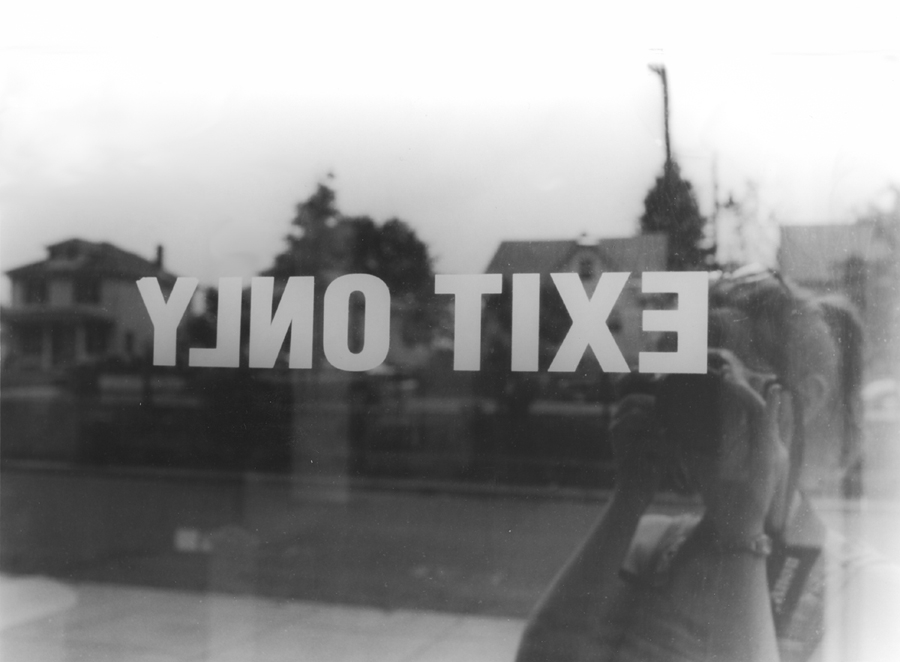
- I really wanted to use this photo from when I took Photo I.
- It is vaguely reminiscent of Sartre's No Exit. I always liked that play because my middle name is Inez and I act like her sometimes.
- Is death (the exit) really the ultimate act of life? That reminds me of the refrain "life sucks and then you die" but I can't help but think there's more to life than death. Why is it that life doesn't make sense without death? Death is the absence of life. Is life the absence of death?
